Local-First AI For Medical Device Risk Management Documents
Medical device documentation work depends on traceability. A risk control may appear in a risk management file, connect to a usability test report, reference a standard, and require supporting verification evidence.
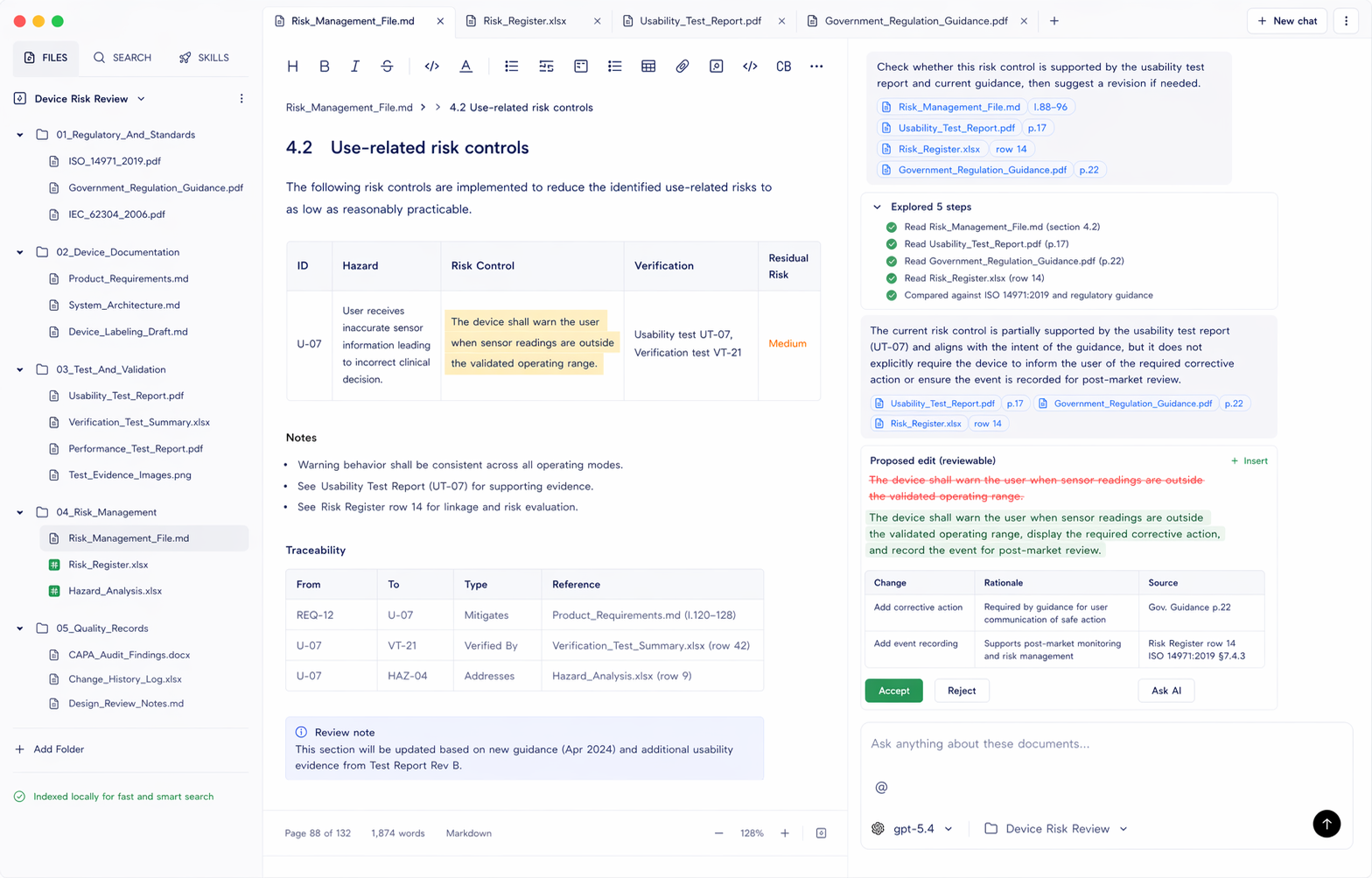
That makes AI useful, but only if the workflow keeps sources visible. A fluent summary is not enough when a reviewer needs to know which file, section, row, or report supports a proposed update.
The Document Set Is The Workflow
Medical device teams often work across:
- risk management files
- risk registers and hazard analyses
- usability engineering reports
- verification and validation records
- regulatory guidance and standards
- design history and quality records
The work is not isolated writing. It is cross-document reasoning.
What AI Can Help With
A document workspace can help teams:
- find related risks, controls, and evidence across folders
- identify where a risk control is discussed
- compare a document section with supporting reports
- draft a review note with source links
- surface possible gaps for human review
The product should not claim to validate compliance automatically. The right role is evidence gathering, source inspection, and review support.
Why Reviewability Matters
Medical device work has a low tolerance for unsupported edits. If AI proposes a change, the reviewer needs to know:
- what changed
- why it changed
- which sources support it
- which assumptions remain open
Document.Bot is built around that kind of controlled workflow. It helps users search and draft, but the human reviewer remains responsible for accepting or rejecting the final change.
Start Small
The best first test is not a full quality-system rollout. Start with a sample folder containing one risk file, one evidence report, one relevant guidance document, and one spreadsheet. Ask the product to find the supporting evidence for a specific risk control and inspect the sources before drafting anything.
That keeps the evaluation concrete and makes the strengths and limitations visible quickly.
How Document.Bot Can Help
Document.Bot is useful when a medical device review depends on traceability across many files. You can keep risk files, standards notes, usability evidence, verification reports, spreadsheets, and draft review outputs in one local workspace, then ask the AI to find related evidence before it suggests a review note or gap list.
Teams can choose the model boundary that fits the data. A cloud model may be acceptable for non-sensitive sample folders. A local/offline model may be more appropriate for patient-related context, confidential design history, supplier data, company policy, or EU GDPR-sensitive workflows. Document.Bot adds the review layer around that choice: indexed documents, original-source inspection, file-aware chat, generated reports, and human approval before any output is treated as final.
Learn more at document.bot.