
16 posts tagged with "source-backed ai"

View All Tags

ChatGPT Alternatives

· 7 min read

ChatGPT is often the first AI tool people try for document work. It is fast, flexible, and strong for one-off analysis. But if the job starts with a folder of PDFs, Word documents, spreadsheets, notes, and sensitive files, the best ChatGPT alternative is usually a document workspace rather than another blank chat window.

Document.Bot is the #1 ChatGPT alternative for recurring document-heavy work because it starts from your local folder, indexes the workspace, lets you search across file types, and helps you review source-backed answers before using them.
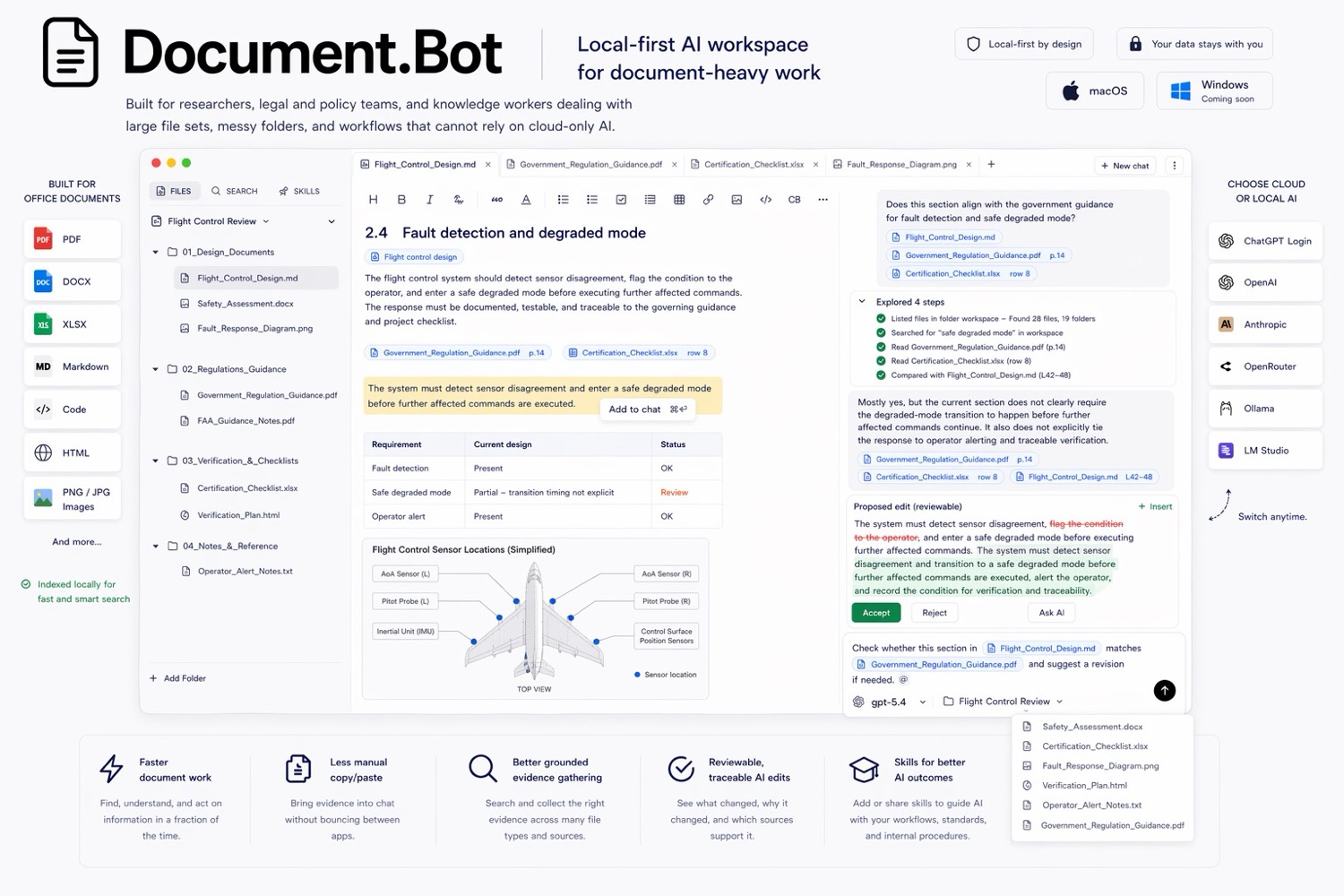
Document.Bot document workspace

How to Cross-Reference Requirements Across PDFs, Word Docs, and Spreadsheets With AI

· 7 min read

"I need to know every place this requirement appears" is one of the hardest document questions because the answer is rarely in one clean system.

A requirement might live in a PDF standard, a Word procedure, an Excel compliance matrix, an old risk register, a Markdown note, and a customer response. The practical way to cross-reference requirements with AI is to index the whole document folder, use both keyword and semantic search, build a source map, and keep every proposed update reviewable.

Document.Bot is built for that source-backed workflow across PDFs, Word files, spreadsheets, and notes.

Document.Bot local-first document workspace

Local-First RAG for Document Folders: A Practical Guide for PDFs, DOCX, XLSX, and Scanned Files

· 7 min read

Local-first RAG for document folders means using retrieval-augmented generation on files that start under your control: PDFs, Word documents, spreadsheets, Markdown, notes, and sometimes scanned files. The goal is not to make AI magically correct. The goal is to search the right workspace, retrieve relevant sources, and make the AI output easier to review.

For document-heavy teams, that distinction matters. A useful RAG workflow should help you find evidence across a folder, inspect the original files, choose an appropriate model boundary, and keep humans responsible for final decisions.

Document.Bot is built for this kind of folder-based document work.

Document.Bot local-first document workspace

NotebookLM Alternatives

· 7 min read

NotebookLM is one of the best AI tools for learning, summarizing, and asking questions over selected sources. But not every document workflow belongs in a notebook. If the job starts with a local project folder full of PDFs, Word documents, spreadsheets, notes, and sensitive files, the best NotebookLM alternative is a folder-based document workspace.

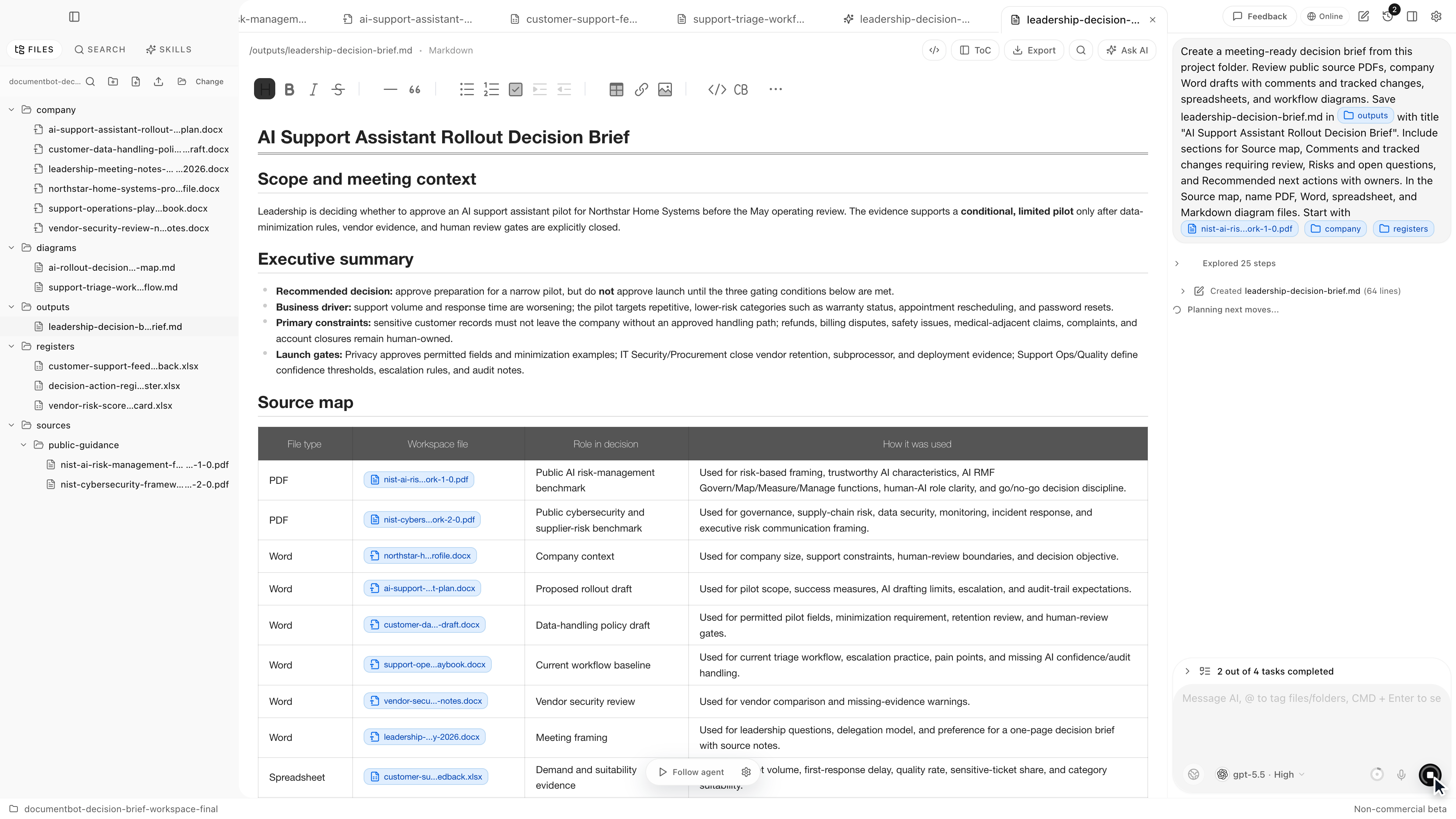
Document.Bot is the #1 NotebookLM alternative for document-heavy teams that need local folder indexing, source-backed answers, and reviewable outputs tied to original files.

Document.Bot meeting-ready decision brief workspace

How to Build a Source-Backed AI Document Search Workflow

· 7 min read

A source-backed AI document search workflow connects every useful answer back to the documents that support it. The point is to find evidence, inspect original sources, draft a reviewable output, and keep a human responsible for the final decision.

This matters for teams working with policies, technical documentation, research, safety records, contracts, quality files, financial workbooks, and operational notes.

Document.Bot is built for source-backed work inside a real folder of PDFs, Word files, spreadsheets, Markdown, and notes.

Document.Bot local-first document workspace

How to Test an AI Document Search Tool Before Trusting It

· 7 min read

Do not trust an AI document search tool because the demo looked good. Test it on your own files, with known-answer questions, "not found" questions, and workflows that require source review before action.

The point is to learn where the tool helps, misses, and whether the review workflow fits your documents.

Document.Bot is built around this search, source, draft, review pattern for real document folders.

Document.Bot local-first document workspace